The complete study platform
Your entire semester, in one place.
Add your course material once. Tandral turns it into lessons, flashcards, practice, exams, podcasts, and a day-by-day plan, from the first lecture to the final.
Free plan included · No credit card required









How it works
From a folder of PDFs to exam-day ready.
Add your material
Upload your material and pick the pages you want to study.
Choose how to study
Those pages become a lesson, flashcards, a quiz, a podcast. Whatever you need today.
Follow the plan
A study plan, day by day, so you are ready on time.
Every format
Every way you study, in one place.
Every study tool is built from the material you upload.
Teaching
Lessons from your material, one chapter at a time, with a quiz after each.
Flashcards
From your material, or written by you. Color-coded, so the answer comes back to you.
Practice
One problem at a time, step by step, with feedback on each step.
Evaluation
Quizzes, or a full timed exam simulation. Feedback on every answer.
Mind map
Concept maps built from your material, or drawn by you.
Video
Your material as a narrated video, with captions.
Summary
All of it, or just the key ideas.
Audio
Study out loud, four ways, from a two-host podcast to teaching it back.
Essay
Outlines, wording help, and real sources, cited for you.
Chat
Ask your material anything.
Presentation
Real slides you can edit, then export to PowerPoint.
Study planner
A study plan that keeps you on time for exam day.
Learn it
Taught to you, chapter by chapter.
Tandral turns your pages into a lesson: clear chapters, taught one at a time, with a quick quiz after each.
- See the plan first. The chapters show before the lesson starts.
- Focus where it counts. Point it at one topic, or say what matters most.
- A quiz after each chapter. A few questions, so you know it stuck.
lessons · read aloud · quiz after each chapter
Chapter 4 · The nervous system
~6 min readYour nervous system moves information the way a campus moves students: along fixed routes, with priority lanes. Every signal travels through cells called neurons, passing from one to the next across a small gap called the synapse.
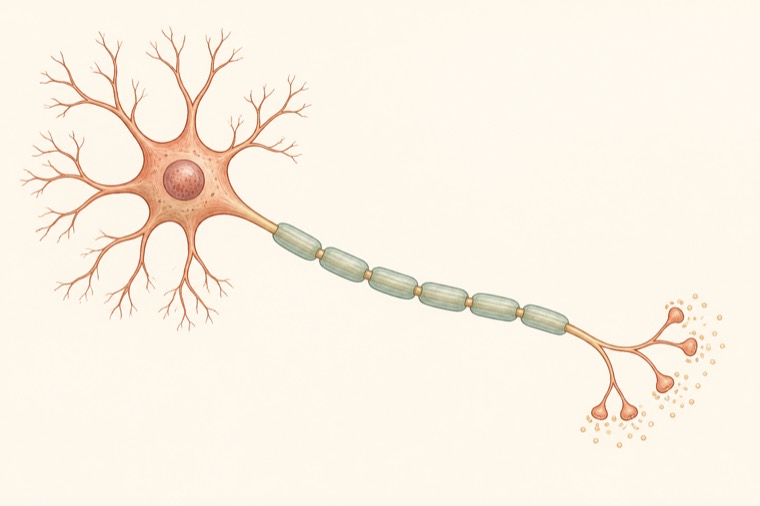
Figure 4.1 · One neuron, end to end
Axons wrapped in a myelin sheath carry signals up to thirty times faster than bare ones. Where that sheath is damaged, the signal slows or stops, which is what makes the diagram on page 84 worth knowing.
She said this comes up every year: name the gap, not just the cell.
Signals only cross the gap when enough of them arrive at once. Below that line nothing happens at all, which is why the response is called all or nothing.
1. A damaged myelin sheath speeds the signal up.
2. Which of these speed a signal along an axon?
Work it out
One problem, one step at a time.
For the subjects you can't just memorize: math, chemistry, physics, code. You work the problem step by step, and Tandral checks each step as you go.
- Answer your way. Type it, draw it, write the math, or code it.
- Feedback on every step. You see where you went wrong, and why.
- Stuck is allowed. Open an example, then keep going.
type · draw · math · code · checked at every step
A right triangle has legs of 3 cm and 4 cm. How long is the hypotenuse?
1. Which relationship connects the three sides?
In a 5-12-13 triangle: 5² + 12² = 13²
a² + b² = c²
a² + b² = c²
2. Put the two legs in.
With legs 5 and 12: 5² + 12² = 13²
3² + 4² = c²
3² + 4² = c²
3. Sketch it and mark the hypotenuse.
The hypotenuse is the side opposite the right angle.
Test yourself
Quizzes and exam simulations, before the real one.
Quick quizzes, or a full timed exam simulation. Feedback on every answer, even the written ones.
true or false · multiple choice · short answer · long answer · timed exam simulation
Insulin raises the concentration of glucose in the blood.
You: True · Correct: False
Which hormone raises blood glucose between meals?
You: Insulin · Correct: Glucagon
Where in the pancreas is insulin made?
You: Alpha cells · Correct: Beta cells
The learning loop
What you missed becomes what you study next.
What you got wrong becomes your next lesson. Study it, then test yourself again.
video · lesson · flashcards · practice · then test yourself again
Out loud
Study with your voice, not just your eyes.
Podcast
Two hosts walk through your chapter.
Already playing. Turn the sound on to hear the hosts.
Ask me questions
It quizzes you on your own material.
Already talking. Turn the sound on to listen in.
Study together
Study together, on a video call.
Invite a friend, then study side by side and send each other what works.
Two students chat, start a video call, and send each other a flashcard deck, a quiz, a video lesson and a teaching session. Everything either one shares opens on both sides.
Watch it
Your material, as a video.
Made from a real course reading. Every word on screen, and you can jump to any part.
Already playing. Turn the sound on to hear it.
Remember it
Cards that come back until they stick.
Flashcards from your material, or ones you write yourself. Flip, answer, be honest. The ones you miss come back.
- Only the topic you need. Up to 50 cards, on the topic you choose.
- Color-coded key terms. Forget the answer, and the colors help you build it back.
- Redo just the misses. Missed cards get their own pile.
up to 50 cards · or write your own
What does the myelin sheath do?
It insulates the axon, so the signal travels faster.
Write it
From blank page to bibliography.
Describe the assignment, then write it yourself with help that stays yours: an outline, a first line when you're stuck, real sources cited for you.
- Sources you can check. Real papers, with a link to each. APA, MLA, Chicago and more.
- Nothing missing. A checklist for each section, so you cover it all.
- Hand it in properly. Export to Word when it's done.
10 outline types · 7 citation styles · export to Word
The Ethics of Gene Editing
1168 wordsGermline editing raises questions that somatic therapies do not, because the changes are inherited by every generation that follows. The line between treating disease and selecting traits is easier to draw in principle than in policy1. Both sides of that line deserve the same scrutiny, and the policy is written by people who will not live with what it decides2
- 1.Doudna, Jennifer A. 2020. “The Promise and Challenge of Therapeutic Genome Editing.” Nature 578 (7794): 229-36.
- 2.Baylis, Françoise. 2019. Altered Inheritance: CRISPR and the Ethics of Human Genome Editing. Cambridge, MA: Harvard University Press.
Present it
From your pages to the projector.
A real deck in a real editor: up to twenty slides, fourteen themes, every element yours to move. When it is ready, export it to PowerPoint.
a real .pptx, opens in PowerPoint
one pick, and the whole deck follows
The Cardiovascular System
9 slides
Take it down
Write it by hand, on the page itself.
Beyond studying
Deadlines and to-dos, in the same place.
To-do & Calendar
Assignments that say "2 days left", and study sessions on a real calendar.
From real students
Take their word for it.
On camera
real students, real phones.
"I used to use ChatGPT, but it just didn't work that well for me. Then I found Tandral, and it completely changed the game."
"Honestly, it saved my life. It's a 10/10 for me, I have no complaints."
"With Tandral, you feel less overwhelmed and more organized."
"As a nursing student, I struggled with time management and studying. Tandral changed that."
FAQ
Yours. You pick the pages, and everything is built from them.
It can get things wrong. So every graded answer shows its reasons, and your pages stay in view. If something looks off, check your pages.
No. You answer the steps, you take the tests, you write the essay. What you learn stays yours.
Yes. No credit card, and enough to take one chapter through a lesson, a deck, and a test.
Top up or change plans any time. Tokens you buy do not expire. Cancel any time.
It works from whatever material you bring it, in 18 languages. Phone, tablet, and computer all run it, and it installs as an app on any of them.
Bring your next exam under control.
Free plan included · No credit card required